West Morava River
A History of the Vampire in Popular CultureWest Morava River is a central geographic marker in the account of Arnold Paole, a Serbian hadjuk whose death and alleged return as a vampire became part of the wider eighteenth-century vampire panic. The river’s significance is not scenic but evidentiary: it places a disputed supernatural narrative within a specific rural community, linking a named landscape to fear, disease, folk explanation, and the violent treatment of the dead.
Setting and Historical Context
West Morava River is identified as lying in central Serbia, beside the village of Trstenik. In the narrative, this location belongs to the eastern European region from which many of the oldest vampire stories emerged. The association is therefore geographical as well as cultural: vampire traditions were understood as having largely Slavic origins, while the uncertain etymology of the word vampire was widely connected to the Hungarian vampir and, further back, to the Old Church Slavonik opiri.
The river setting also places Paole’s story within an era when communities had few reliable explanations for clusters of illness and death. During the eighteenth-century vampire craze, entire villages in eastern Europe became convinced that vampires were invading their communities. Suspected corpses were dug up and staked, transforming burial grounds into sites of investigation and collective violence. The West Morava River thus functions as the local anchor for a much broader historical pattern in which fear converted uncertain medical circumstances into a supernatural diagnosis.
Arnold Paole at Trstenik
In 1726, Arnold Paole, a Serbian hadjuk—roughly, a member of an irregular peasant infantry—died at Trstenik after falling from a hay wagon and breaking his neck. Before his death, Paole had claimed that he had been plagued by a vampire some years earlier, probably in the area now known as Kosovo. He said that he had escaped the creature by eating soil from its grave and covering himself with blood, an act whose supposed protective logic is left deliberately doubtful in the account: blood would seem an unlikely defense against a being defined by drinking it.
Paole’s earlier claim became decisive after villagers began to fall ill not long after his death. The community interpreted the sequence through the language available to it. The vampire from Kosovo was believed to have infected Paole, and Paole was now thought to be taking his turn as a murderous creature of the night. The location beside the West Morava River therefore becomes the point at which a personal testimony, a sudden series of illnesses, and communal suspicion are fused into a single causal story.
Exhumation and the Making of a Vampire
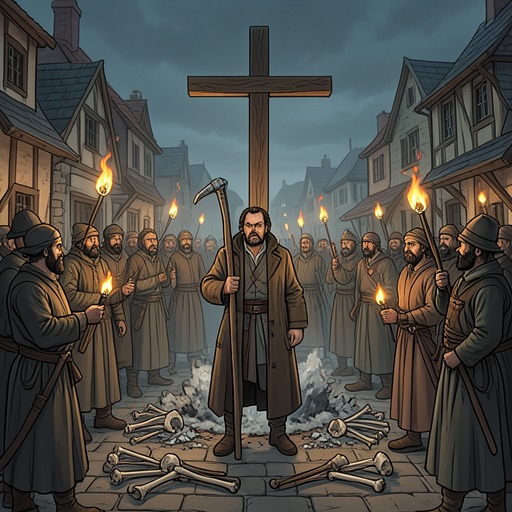
Paole’s body was disinterred, and the villagers were horrified to find what they understood as evidence that he had not decomposed. The account says that the nails on his hands and feet had allegedly fallen off and been replaced by fresh growth. When the corpse was staked, it was said to shriek and bleed from the wound. These details transformed the body from a dead object into apparent proof of vampiric activity, even though they belonged to a pattern of post-mortem observations that could be interpreted differently through modern knowledge of decomposition.
The villagers responded with the most final measure available to them: they cremated Paole’s remains. This action was intended to prevent further attacks and to close the danger represented by a corpse that was believed capable of leaving its grave. The episode shows how the vampire story operated as a practical system of control. Exhumation supplied inspection, staking supplied restraint, and cremation supplied irreversible destruction; each ritual answered the fear that ordinary burial had failed.
From Local Incident to Recurrent Panic
Paole’s case was not treated as an isolated curiosity. The account places it within a series of deadly vampiric outbreaks in the same area. In 1731, thirteen deaths occurred in one Serbian village in sufficiently rapid succession to alarm the population. A doctor specializing in infectious diseases was sent to investigate and concluded that malnutrition was almost certainly responsible, but the villagers rejected that explanation as too simple and insisted that vampires had attacked the community.
The doctor was persuaded to exhume the suspected corpses. He found that many had not undergone major decomposition and that their mouths appeared to contain what he believed to be fresh blood. Officials in Vienna, unwilling to accept the initial findings without further examination, sent the respected military surgeon Johann Flückinger with other doctors and army officers as witnesses. Flückinger and his companions likewise reported little decomposition and observed that some bodies appeared to have become plump. In this context, the West Morava River episode stands as an early point in a recurring cycle: unexplained deaths prompted suspicion, suspicion prompted exhumation, and the physical changes of corpses were read as confirmation of the supernatural.
Documentary Afterlife
The West Morava River story also entered a documentary and scholarly chain that extended far beyond Trstenik. Johann Flückinger and his companions did not merely hear village testimony: they examined the bodies, recorded their observations, and cut the heads off the suspected vampire corpses before reburying them, an action intended to prevent a recurrence. The case thereby moved from local fear into an official record, where military authority, medical inspection, and the language of vampirism reinforced one another even while the physical evidence remained open to other explanations.
That process belonged to a broader European habit of recording revenants. Walter Map, writing in the twelfth century in De Nugis Curialium, collected tales of figures now recognizable as vampires but then generally described as revenants, or the undead. In one story, Bishop Gilbert Foliot advised that a corpse which repeatedly rose from its grave should be exhumed, its neck cut through with a spade, and its body and grave sprinkled with holy water. William of Newburgh likewise discussed revenants in Historia Rerum Anglicarum while presenting himself as impartial about supernatural claims, though the period still allowed the possibility of life after death. The West Morava River episode thus belongs to a long textual tradition in which reports of returning corpses were preserved through clerical, historical, and administrative forms.
From Rural Report to Vampire History
The eighteenth-century material was later gathered into arguments about whether vampires existed and what such reports meant. Antoine Augustin Calmet, a Benedictine monk born in 1672 in Lorraine and later associated with the abbey at Senones, published The Phantom World in 1746 and revised and expanded it in 1751. The work treated apparitions, demons, spirits, revenants, and vampires from Hungary, Bohemia, Moravia, and Silesia, and quoted an account from Lettres Juives describing a vampiric scene in Hungary attested by officers of the tribunal of Belgrade and an imperial officer who claimed to have witnessed the proceedings.
Calmet’s work shows how a local corpse investigation could become part of a learned controversy. Reports connected with Serbia and neighboring regions were no longer confined to villagers or military witnesses; they were excerpted, translated, compared, and placed before readers interested in occult mysteries and the limits of testimony. The West Morava River therefore functions as a point where oral belief, bodily observation, official paperwork, and scholarly compilation meet. Its importance lies less in proving a vampire than in showing how evidence acquired authority as it passed between different institutions.
Medical Fear and Cultural Memory
The significance of the river setting is sharpened by the medical conditions surrounding the vampire panic. In New England during the nineteenth century, tuberculosis spread rapidly through households and was interpreted as the dead returning to drain the life force of surviving relatives. The same explanatory pressure appears in the Serbian accounts: deaths occurred in clusters, communities lacked dependable medical knowledge, and the apparent condition of corpses supplied an emotionally compelling target for fear. In both cases, supernatural narratives offered a sense of control over disasters that otherwise seemed arbitrary.
The West Morava River episode consequently illustrates a recurring pattern rather than an isolated superstition. A death was followed by illness, illness was assigned to transmission by a vampire, and the suspected dead were subjected to inspection and destruction. Later accounts of the eighteenth-century vampire craze describe entire villages hunting and staking supposed vampires, while the examination of corpses in Serbia gave these fears a formal appearance. The river became part of cultural memory because it attached this sequence of accusation, investigation, and ritual violence to a precise landscape.
Narrative Significance
As a location, the West Morava River is defined by what happened beside it and by the explanations imposed upon those events. It anchors Arnold Paole’s story in central Serbia, links the narrative to Trstenik and the wider Slavic geography of vampire folklore, and provides a bridge between a single death in 1726 and the larger wave of reports that followed in 1731. The place is neither a passive backdrop nor evidence of the supernatural in itself. It is the geographical coordinate that allows competing systems of knowledge—folk belief, infectious-disease reasoning, military authority, religious tradition, and later literary history—to confront one another.
That tension is the location’s enduring meaning. Before Gothic fiction standardized the elegant, seductive vampire, older traditions described physically ugly revenants, blood-drinking women such as Lamia and Astryiah, the impundulu familiar of a witch, and other culturally distinct life-sucking creatures. Scottish tales of the baobhan sith similarly joined seduction to murder, while medieval stories treated the returning dead through Christian ritual. The West Morava River belongs to this older, unstable world of local bodies and contested explanations. Its place in vampire history comes from the fact that a rural Serbian landscape could become, through testimony and repetition, a durable site in the imagined geography of the undead.